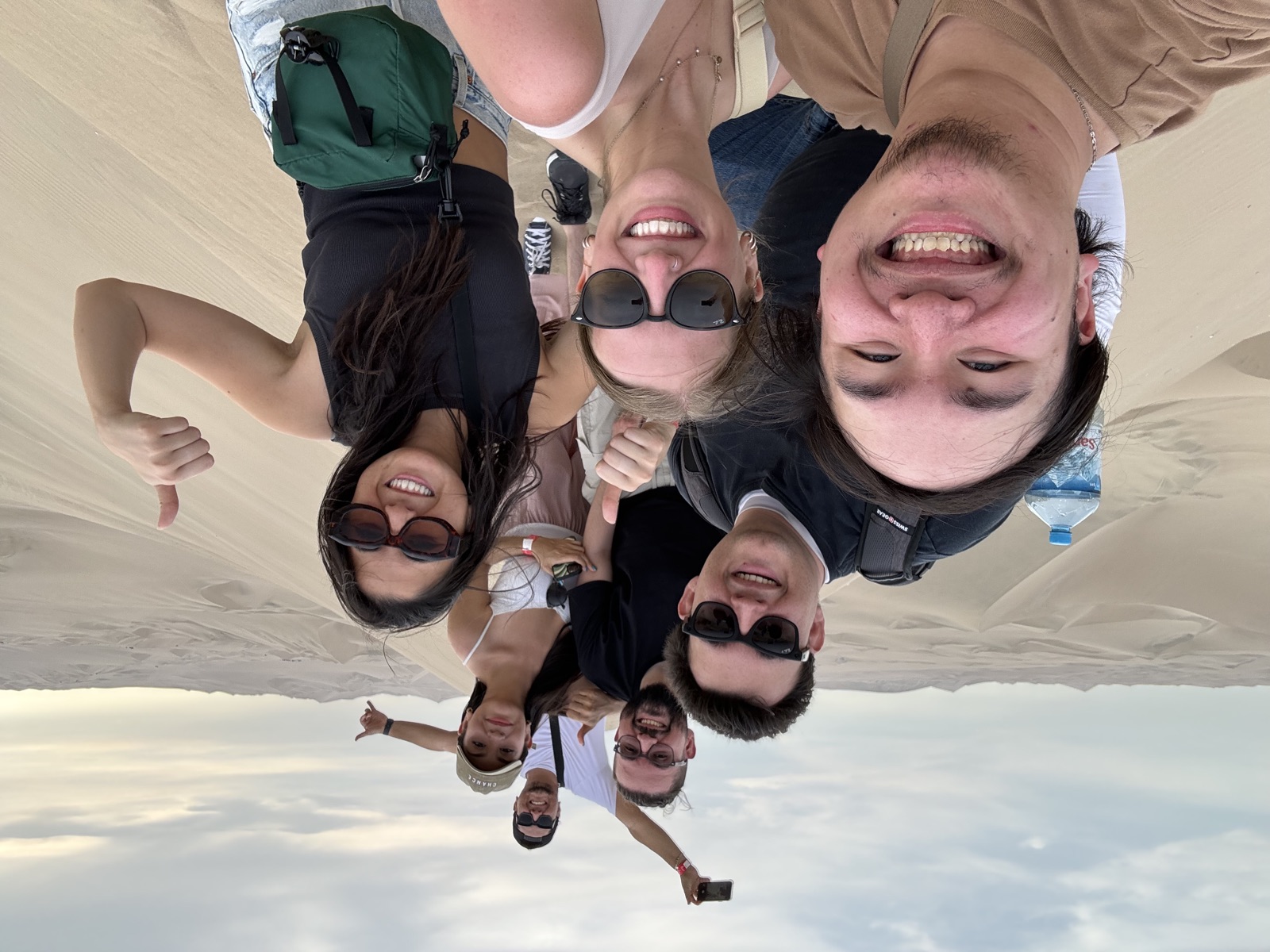
The thing about the desert that photographs never capture is the silence. Not quiet, silence. The complete, unbroken absence of sound that happens when there is nothing alive for miles in any direction, no trees for wind to move through, no water to make noise, no insects, no traffic, no hum of electricity. Just rock and sand and sky and the sound of your own breathing, which suddenly seems very loud.
I’ve spent time in deserts across several continents, the Sahara, the Atacama, the Wadi Rum, the Namib, and the experience is remarkably consistent regardless of geography. Something happens to your thinking when the landscape strips away everything extraneous. The mental clutter quiets. The urgent things stop feeling urgent. The essential things become very clear.
The Reduction
Deserts are landscapes of reduction. There is less of everything: less water, less vegetation, less shade, less life, less noise, less distraction. What remains is geology and light. The bones of the earth, exposed.
This reduction does something to perception. In a city, your senses are constantly processing: signs, faces, sounds, smells, movement. The bandwidth is fully allocated. In a forest, there’s complexity, layers of canopy, undergrowth, birdsong, the play of shadow. Beautiful, but busy.
In the desert, the visual field simplifies to a degree that feels almost abstract. A horizon line. A gradient of color from sand to sky. Shadows that move with mathematical precision as the sun tracks overhead. The simplicity frees up something in the mind. With less to process externally, the internal processing sharpens.
I’ve had some of my clearest thinking in arid landscapes. Not in a mystical sense. I’m not suggesting the desert is a spiritual experience, though many traditions would disagree with that dismissal. In a practical sense. The ideas that had been tangled for weeks would untangle. The priorities that felt equally weighted would sort themselves. The decisions I’d been avoiding would present themselves with uncomfortable clarity.
The Light
Desert light is different from any other light on earth. The absence of humidity means the air doesn’t scatter the sun’s rays the way it does in tropical or temperate climates. The result is a clarity of illumination that makes everything look hyperreal. Colors are more saturated. Edges are sharper. Shadows have definition that would make an architect weep.
In the Wadi Rum, the sandstone desert in southern Jordan, the light at dawn turns the rock formations a shade of red that doesn’t exist anywhere else in my visual memory. It lasts maybe twenty minutes. Then the sun climbs and the color shifts to orange, then gold, then the bleached white of midday. Each hour is a different desert.
The Atacama, in northern Chile, has the clearest skies on the planet. The world’s most powerful telescopes are there because the atmosphere is so transparent that you can see further into space than from anywhere else on earth. Standing in the Atacama at night, the Milky Way isn’t a suggestion. It’s a structure. You can see its shape. You can see the density of it. The light that reaches your eyes has been traveling for thousands of years, and nothing in the atmosphere has interfered with it.
This quality of light changes how you see everything. It’s addictive. Returning to a humid city after time in the desert, the air feels thick, the colors feel muted, and you realize that you’d been living in a permanent soft filter without knowing it.
The Scale Problem
Deserts also recalibrate your sense of scale, which I think is useful for anyone who spends too much time in rooms staring at screens.
In the Sahara, you can see for distances that the brain isn’t designed to process. The horizon is so far away that objects approaching, a vehicle, a camel caravan, are visible for half an hour before they arrive. Time and distance merge into something fluid. Walking across open sand, you can aim for a rock formation that looks thirty minutes away and reach it in two hours. The desert lies to you about proximity because there are no reference points to anchor your estimates.
This recalibration is humbling in a specific and productive way. It reminds you that most of the problems you’re obsessing over exist at a scale that is, relative to the landscape you’re standing in, microscopic. The quarterly revenue target. The client who’s unhappy. The email you’ve been drafting and redrafting. These are real concerns. They are also very small when measured against the geological time visible in a canyon wall that’s been eroding for fifty million years.
What You Bring Back
The practical value of desert time, and I do think of it in practical terms, because I’m a person who runs a business and can’t disappear into the Sahara indefinitely, is the editing it does to your priorities.
Every time I return from an arid landscape, my to-do list gets shorter. Not because I’ve completed tasks, but because the desert has a way of revealing which tasks actually matter. The ones that survive the silence are the essential ones. The rest were noise pretending to be signal.
There’s a design principle that applies here: the best work isn’t done when there’s nothing left to add, but when there’s nothing left to remove. The desert is that principle made landscape. It has removed everything that doesn’t need to be there, and what remains is beautiful precisely because of what’s absent.
I think everyone should spend time in a desert at least once. Not for the Instagram photos, though the photos will be extraordinary. For the editing. For the silence. For the light that shows you things as they actually are, without the comfortable distortion of atmosphere.