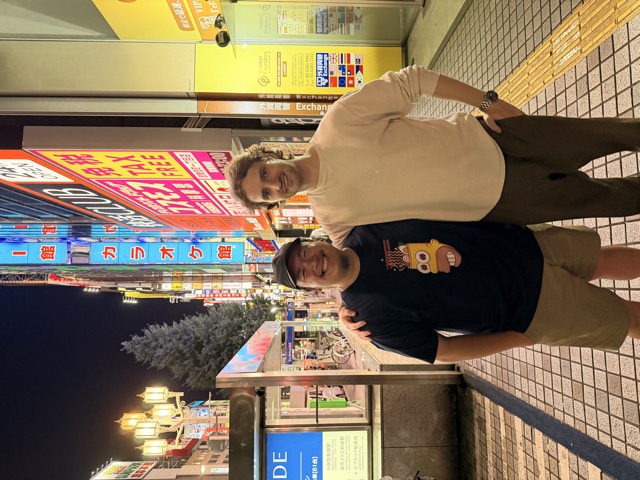
I’ve spent enough time in enough countries to know that I’m a composite. Not in the vague, “citizen of the world” way that people put in their Instagram bios. In the specific, practical way where the habits I follow every day were picked up somewhere on a map, and I can usually tell you exactly where.
My morning routine is Japanese. My approach to design is Italian. My work ethic has a German streak that sometimes annoys even me. And the way I build relationships, the warmth, the directness, the insistence on making things personal, is Brazilian through and through, borrowed from my co-founder Bruno and the years I spent in Sao Paulo watching him turn strangers into allies in under ten minutes.
None of this was deliberate. I didn’t travel with a checklist of cultural traits to collect. But when you spend real time in a place, not two weeks at a hotel, but months, working, eating, navigating the mundane rhythms of daily life, things seep in. And they stick.
Germany: The System
I spent time in Berlin and Munich in my mid-twenties, and Germany rewired how I think about process.
Germans don’t romanticize work. They don’t post about their hustle or their grind. They show up, they execute with precision, and they leave. The workday in Germany has a beginning and an end, and both are respected. But between those bookends, the efficiency is almost unsettling.
What I took from Germany wasn’t the efficiency itself, everyone admires German efficiency; it’s practically a cliche. What I took was the philosophy underneath it: that good systems eliminate the need for heroics. If you’re constantly pulling all-nighters to hit deadlines, you don’t have a work ethic problem. You have a systems problem.
At PipelineRoad, we obsess over systems. Client onboarding has a documented process. Content production has a workflow. Weekly reviews follow a template. Not because we’re rigid, but because the system handles the routine so the humans can focus on the creative.
I think about this every time I see an agency bragging about their all-hands-on-deck culture, their war rooms, their midnight pushes to get a campaign out the door. That’s not dedication. That’s a systems failure being dressed up as passion.
Germany taught me that the most impressive thing isn’t working hard. It’s making hard work unnecessary through better engineering.
Italy: The Surface Matters
In Italy, beauty is not optional. It’s not a nice-to-have. It’s a prerequisite.
I spent several months between Milan and Florence, and what struck me wasn’t the famous art or the architecture, though those are extraordinary. What struck me was the everyday beauty. The way a barista arranges cups. The typography on a restaurant menu. The fold of a napkin. The care taken with things that, in most countries, nobody would notice.
In America, there’s a strain of thinking that says substance and style are opposites. That caring about how something looks is superficial. That real quality is invisible.
Italy demolished that idea for me.
A plate of cacio e pepe at a good Roman trattoria is three ingredients. Pasta, pecorino, black pepper. There is nowhere to hide. The presentation isn’t separate from the quality. It is the quality. The way the pepper is cracked, the way the cheese clings to the noodle, the plate it arrives on. Every surface-level detail is a signal of the care underneath.
I brought this back to everything we design. Our proposals don’t just contain good strategy, they look good. Our client dashboards aren’t just functional, they’re clean and considered. Our emails have proper formatting, intentional white space, and typography that someone actually thought about.
This isn’t vanity. It’s communication. When something looks like it was made with care, the viewer trusts that it was made with care. When something looks thrown together, no amount of “but the content is great” saves it.
Andre, our senior designer, understands this instinctively. He’s the person on the team who will refuse to ship something because the spacing is four pixels off. In another culture, that might seem precious. In the culture we’ve built, which is partly Italian, whether Andre knows it or not, it’s essential.
Brazil: The Relationship First
Bruno is from Sao Paulo, and working with him for the past several years has been a masterclass in Brazilian relationship culture.
In the US, business relationships are transactional by default. You meet, you assess mutual utility, you exchange value, you move on. The personal stuff, family, interests, how your weekend was, is small talk. It’s the appetizer before the entree. Everyone knows the real meal is the deal.
In Brazil, the personal stuff is the deal.
I’ve watched Bruno spend forty-five minutes of a one-hour meeting talking about the client’s kids, their vacation, a restaurant they tried last week. And then in the last fifteen minutes, close a deal that I’d been trying to close over email for three weeks. Because by the time he gets to business, the client doesn’t feel like a client. They feel like a friend. And people do things for friends that they’d never do for vendors.
This was uncomfortable for me at first. I’m naturally task-oriented. I want to get to the agenda. I want to be respectful of people’s time, which I used to think meant being efficient with it.
But Bruno showed me that respecting someone’s time and respecting someone are two different things. Sometimes the most respectful thing you can do is slow down and see the person, not just the opportunity.
I’ve adopted this. Not as well as Bruno does it, I don’t think anyone does it as well as Bruno, but enough that our client relationships feel genuinely personal. We know their stories. They know ours. And when things get hard, as they inevitably do in agency work, that reservoir of personal connection is what keeps people in the room instead of walking out.
Japan: The Details
I visited Japan three times before I understood what I was seeing. The first two trips, I was just awed. By the third trip, I started paying attention to the mechanics of what makes Japan feel the way it feels.
It’s the details. Relentless, almost compulsive attention to details that most cultures would consider beneath notice.
The way a convenience store clerk places your change on a small tray and pivots it toward you with two hands. The way a train platform is marked with exact lines showing where the doors will open. The way a bento box arranges six different elements so that no two colors or textures are adjacent. The way a hotel room has a flashlight by the bed, a magnifying mirror in the bathroom, and slippers in exactly your size waiting at the door.
None of these things are individually remarkable. But collectively, they create an experience of being in an environment where someone has thought about everything. Where nothing was left to chance or laziness.
I brought this obsession home. At PipelineRoad, we have a checklist for client deliverables that includes things most agencies would never bother with. Is the file named correctly? Is the date format consistent? Are all the links tested? Is the header hierarchy logical? Is there a single typo anywhere?
These seem trivial until you realize that clients notice. They may not consciously register that every deliverable arrives perfectly formatted and error-free. But they feel it. It registers as professionalism, as reliability, as: these people care about the small things, which means I can trust them with the big things.
Japan taught me that excellence isn’t about the grand gestures. It’s about the accumulation of a thousand tiny choices, each one made with intention.
America: The Optimism
I’ve been in the US long enough to have absorbed something that I think Americans undervalue because they swim in it: the fundamental optimism.
The belief that things can be built. That next year can be better than this year. That a company started in a spare bedroom can become something real. That an industry you know nothing about can be learned, entered, and reshaped.
This optimism is mocked in other countries. Europeans especially find it naive. And sometimes it is naive, not every startup should exist, not every founder is destined for greatness, and the American habit of celebrating effort regardless of outcome can feel hollow.
But the alternative is worse. The alternative is the cautious, permission-seeking, risk-averse posture that I’ve seen in other business cultures. Where you don’t start a company until you’re sure it will work. Where you don’t enter a market until you have credentials. Where you don’t claim an ambition out loud because someone might laugh.
I choose the optimism. Not blindly. But deliberately. Because the energy required to build something from nothing has to come from somewhere, and I’ve never seen it come from skepticism.
The Blend
I don’t think of myself as multicultural in the academic sense. I think of myself as someone who has been lucky enough to be shaped by places, and who tries to keep the best of each.
German systems so the work runs smoothly. Italian design sense so the work looks like it matters. Brazilian warmth so the relationships feel real. Japanese detail orientation so nothing slips through. American optimism so we keep building even when it’s hard.
It’s not a perfect blend. The German efficiency sometimes clashes with the Brazilian warmth. You can’t optimize a relationship. The Japanese attention to detail sometimes slows down the American bias for action. The Italian aesthetic standards sometimes make simple things take too long.
But the tension is the point. Culture isn’t a single note. It’s a chord. And the best work, the best life, comes from learning to hold multiple notes at once without resolving them into something simpler than they are.
I’m still collecting. Every country I visit, every culture I spend time in, something new gets added to the composite. It never feels finished. I don’t think it’s supposed to.