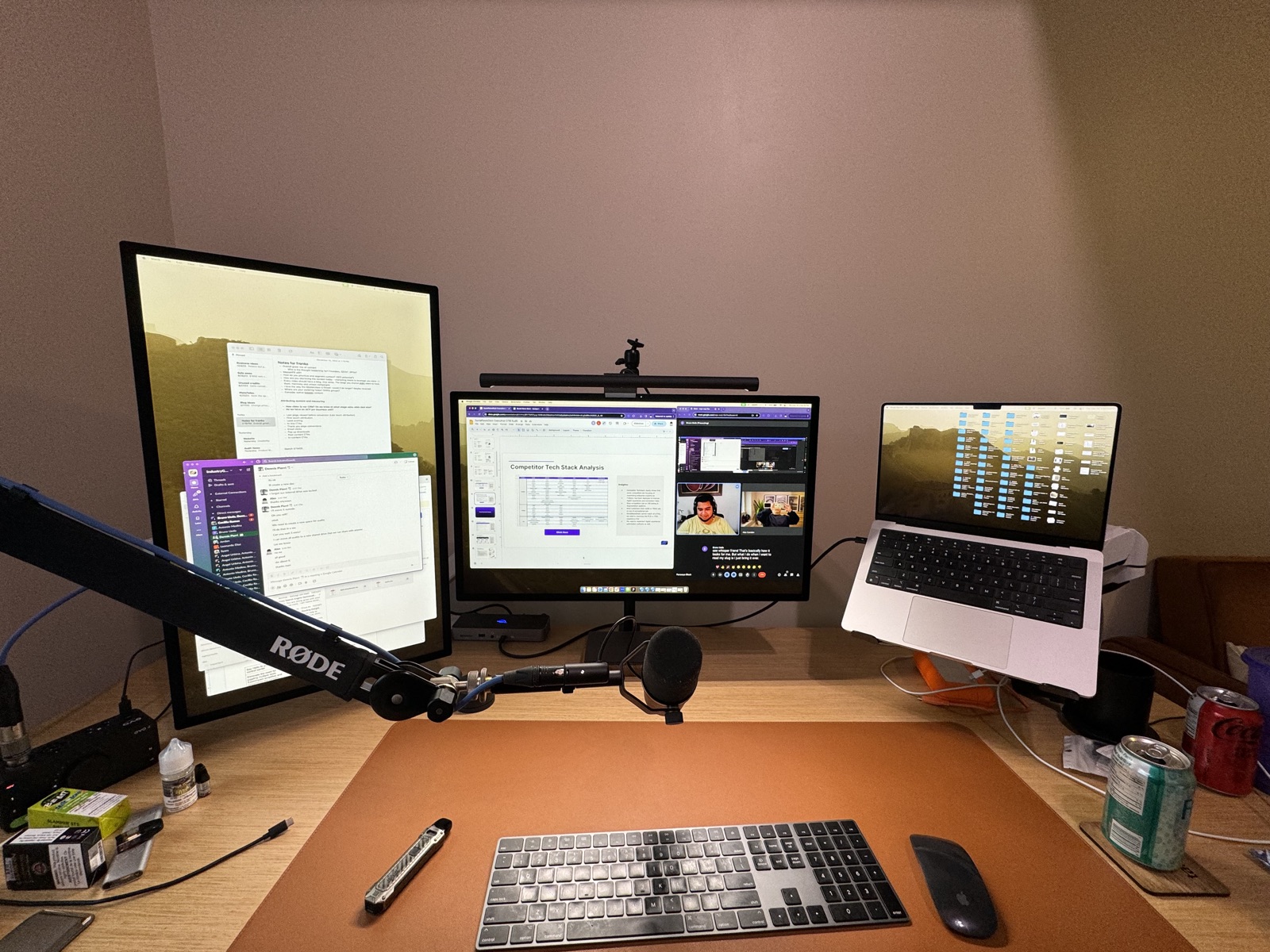
Every “tools I use” article has the same problem: it’s either a sponsored listicle disguised as personal recommendation, or it’s so aspirational that it describes a workflow the author wishes they had rather than the one they actually use.
This is neither. These are the actual tools I reach for every day, why I chose them, and, equally important, what I’ve stopped using and why. No affiliate links, no sponsorship disclosures, no “use code ALEX for 20% off.”
Writing
I do most of my writing in plain text files. Markdown, specifically. I’ve tried every writing app, Notion, Craft, Ulysses, Bear, iA Writer, Google Docs, even Word for a dark period I’d rather not discuss.
I keep coming back to markdown in VS Code. It sounds absurd for someone who isn’t primarily a developer, but the combination of speed, flexibility, and zero distraction is hard to beat. No formatting toolbar begging for attention. No drag-and-drop blocks. No collaborative features pinging me while I’m trying to think. Just text.
For collaborative documents that need to be shared with clients, I use Google Docs. Not because I love it. I find the interface cluttered and the real-time collaboration more distracting than helpful most of the time. But it’s where clients are. Fighting the collaboration tool your clients already use is a losing battle.
The tool I stopped using: Notion for writing. Notion is excellent for structured data, wikis, and project management. It’s terrible for long-form writing. The block-based editor interrupts the flow of prose. Every time I hit enter, I’m creating a new block instead of a new paragraph, and the difference is subtle but maddening. Notion is where I organize. It’s not where I think.
Project Management
We run PipelineRoad on a combination of Linear and a shared markdown workspace. Linear handles tasks, sprints, and client deliverable tracking. The markdown workspace handles strategy documents, brand guides, meeting notes, and everything that’s more narrative than task.
I tried Asana, Monday, ClickUp, and Basecamp before landing on Linear. The thing that sold me was speed. Linear is fast in a way that other project management tools aren’t, keyboard shortcuts for everything, instant search, minimal load times. When you’re switching between eight client contexts in a day, milliseconds of interface lag compound into real frustration.
The controversial opinion: I think most project management tools are solving for features that small teams don’t need. Gantt charts, resource allocation views, time tracking, custom automations, these are valuable at scale, but for a team of five managing eight clients, they’re overhead. I’d rather have a fast, simple tool that we actually use than a powerful tool that we underuse because it’s cumbersome.
Communication
Slack for internal team communication. I have a complicated relationship with Slack. It’s indispensable and it’s a productivity destroyer, sometimes in the same hour.
My approach: I check Slack in batches, roughly three times a day. I’ve turned off all notifications except direct mentions. I’ve left every channel that isn’t directly relevant to active work. The “unread” badge is permanently ignored. If something is truly urgent, my team knows to call me.
Email for client communication. I know this is considered old-fashioned in some circles. I don’t care. Email creates a natural pace that Slack doesn’t. When a client sends me an email, they don’t expect a response in three minutes. That breathing room is valuable for both sides.
Loom for async video. When something is too complex for a Slack message and too informal for a scheduled meeting, I record a Loom. Three to five minutes, talking through a strategy question or reviewing a deliverable. Clients love it because it feels personal without requiring everyone to synchronize their calendars.
AI Tools
I use Claude daily. For first drafts, for brainstorming, for research synthesis, for working through strategic problems. It’s become as fundamental to my workflow as a search engine.
But I want to be specific about how I use it, because “I use AI” is meaningless without context.
I use AI as a thinking partner, not a replacement for thinking. When I’m working through a positioning challenge for a client, I’ll describe the problem to Claude, ask for frameworks, push back on its suggestions, and iterate. The output is never the deliverable. It’s the raw material that I shape, cut, and rewrite based on everything I know about the client that the AI doesn’t.
I use AI for first-draft content that gets heavily edited. Maybe 30% of the original AI text survives into the final version. The value isn’t the words. It’s the speed of getting to a draft I can react to. I write better when I’m editing than when I’m generating from a blank page.
I do not use AI for anything that requires genuine understanding of a client’s specific context, competitive dynamics, or organizational culture. AI can pattern-match against general best practices. It cannot understand that a particular client’s CEO hates the word “synergy” because their last VP of Marketing overused it, or that the sales team is quietly resistant to a new messaging framework because they feel it was imposed without their input. That’s human knowledge.
The tool I stopped using: ChatGPT for client-facing work. Not a quality judgment. I just found that Claude handles long, complex prompts better for the kind of strategic and editorial work I do. Your mileage may vary.
Hardware
MacBook Pro 14-inch, M3 chip. I’ve been on Mac for over a decade and at this point switching would cost me more in muscle memory than any technical advantage would offset.
AirPods Pro for calls and focus work. The noise cancellation is good enough to turn a noisy cafe into a reasonable workspace, which matters when you work from different countries.
A Leuchtturm1917 notebook. Dot grid, hardcover, always within reach. I think better with a pen. Strategy sessions, client meeting notes, random ideas at 2 AM. They all start on paper. The notebook gets digitized selectively. Most of what’s in it never needs to become a document. It just needed to be externalized from my head.
Travel Gear
Since I work from different cities regularly, my setup needs to be portable and reliable.
A Roost laptop stand and an external keyboard. The ergonomics of working on a laptop without a stand are genuinely terrible, and no amount of “I’ll just use it for a few hours” prevents the neck strain. The Roost folds flat and weighs almost nothing. It’s the best $75 I’ve spent on my workspace.
A portable charger that can handle the laptop. This has saved me in airports, train stations, and cafes with no available outlets more times than I can count.
A simple packing cube system. Not a tool in the traditional sense, but the ability to live out of a single carry-on for weeks at a time is a skill that requires infrastructure. Packing cubes, a consistent clothing capsule, and a ruthless approach to “do I actually need this?”, these are the things that make long-term travel sustainable.
The Habits That Matter More Than Tools
Every few months, someone asks me for my “stack” and I give them the list above. And then I watch them optimize their own tools and see minimal improvement. Because tools are maybe 10% of productivity. The other 90% is habits.
The habits that actually move the needle for me:
Writing first thing in the morning, before Slack or email. The first hour of my day is for deep work, strategy, writing, problem-solving. If I open Slack first, that hour evaporates into reactive tasks.
Weekly reviews every Sunday evening. Thirty minutes reviewing what I accomplished, what I didn’t, and what matters most for the coming week. This single habit eliminates about 80% of my Monday morning anxiety.
Batching similar work. All content creation on the same day. All client calls on the same days. All administrative work in one block. Context-switching is expensive, and batching is the cheapest way to reduce it.
Reading something unrelated to marketing every day. A chapter of a novel, a long-form essay about architecture, a piece about marine biology. The best ideas in my work have come from cross-pollination between marketing and something completely unrelated. The tools don’t generate those connections. The reading does.
That’s the list. It’s not revolutionary. Most of these tools are well-known, and most of these habits are common sense. But common sense consistently applied is rarer than it sounds, and it’s more valuable than any tool.