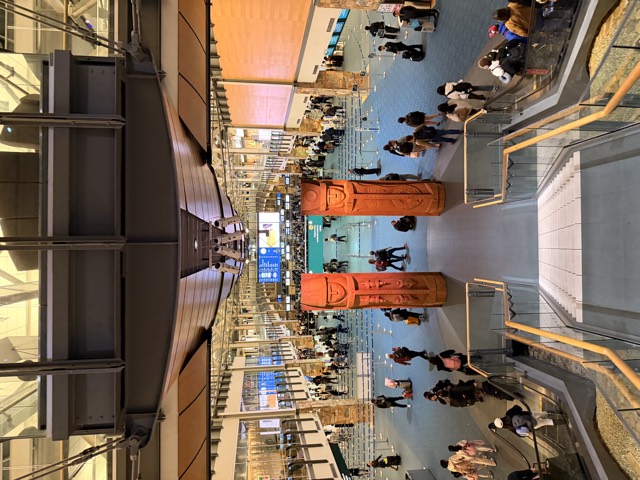
There is no rational explanation for it. You step off a plane or a bus or a train, and something clicks before you’ve even cleared the station. The air, the light, the rhythm of the sidewalk, something in the city matches something in you. You have never been here before, but you recognize it.
I’ve felt this in maybe five or six places across forty-odd countries. Not the majority. Most cities are interesting, some are beautiful, a few are exhausting. But a handful of them produced a feeling I can only describe as recognition. Not nostalgia. Not excitement. Something quieter. A sense that the place operates at your frequency.
The Theory of Fit
I’ve tried to reverse-engineer it. What did those cities have in common? The honest answer is: not much on paper. Different climates, different languages, different economic profiles. One was a sprawling South American capital. Another was a compact European port city. A third was a Southeast Asian town I’d never heard of until someone mentioned it in passing.
But when I think harder, patterns emerge. Each of those places shared a particular relationship between public and private life. The streets were active but not aggressive. There were places to sit without spending money. People walked at a pace that suggested they were going somewhere, but not fleeing something. The architecture felt human-scaled, buildings you could see the top of, streets that curved rather than gridded.
There’s probably neuroscience behind this. Something about how the brain processes spatial environments, how certain ratios of green space to built space trigger comfort responses, how the acoustic profile of a neighborhood, traffic noise versus conversation versus birdsong, maps onto whatever internal template you carry for “safe.” I’m not a scientist. But I trust the feeling because it has been, without exception, predictive. Every city that felt like home on arrival turned out to be a place where I was productive, where I made friends easily, where the days had a natural structure that didn’t require forcing.
What the Opposite Feels Like
The reverse is equally informative. There are cities I’m supposed to love, places with sterling reputations, places friends rave about, places that top every list, where I arrive and feel nothing. Or worse, a low-grade resistance. The city is perfectly fine. The food is good. The sights are impressive. But something doesn’t click.
I used to think this meant something was wrong with me. That I wasn’t cultured enough, or open enough, or trying hard enough. I’ve since stopped believing that. Fit is fit. You don’t have to justify why a particular chair is comfortable. You just sit in it and know. Cities work the same way.
The places that don’t click often share traits too. They tend to be cities organized primarily around efficiency or spectacle. Cities where the default mode of interaction is transactional. Cities where being alone in public feels conspicuous rather than natural. None of these are flaws. They’re just mismatches with my particular wiring.
The Tempo Question
The single most predictive variable, if I had to choose one, is tempo. Every city has a speed, and you either match it or you don’t.
Some cities move at a pace that makes me anxious. Not because they’re fast, I run an agency, I’m fine with fast, but because the speed feels performative. Everyone is rushing, but the rushing doesn’t seem to produce proportional output. It’s motion as social signal.
Other cities are so slow that I start to feel restless within hours. The pace isn’t contemplative; it’s stagnant. There’s a difference between a culture that has chosen slowness as a value and a place that’s simply stuck.
The cities that feel like home occupy a middle register. They move with purpose but without panic. There’s energy in the streets, but also space. You can find a fast lane when you need one and a quiet corner when you don’t. The city doesn’t impose its rhythm on you. It offers a range, and you find your own within it.
Why It Matters
This isn’t just a travel observation. It’s a business one.
When Bruno and I were deciding where to base different parts of our operation, the “feel” of a city turned out to matter more than the spreadsheet metrics. Cost of living, timezone overlap, talent availability, all important. But the cities where our team members thrive are the ones that fit them. Where they can build a daily routine that sustains creative work over months, not just survive a sprint.
I’ve started paying attention to this with clients too. The SaaS founders I work with who seem most grounded tend to be operating from cities that match their energy. The ones who seem perpetually frayed are often in places they chose for strategic reasons but that don’t actually suit them. It’s not the only variable, but it’s one nobody talks about.
Trusting the Signal
I don’t think you can manufacture the feeling. You can’t read enough about a city to know whether it will click. You have to go. You have to arrive without too much expectation and pay attention to what your body tells you before your mind starts rationalizing.
The cities that feel like home are telling you something about yourself. They’re reflecting back a set of values and rhythms you might not have articulated. Paying attention to that reflection, taking it seriously rather than dismissing it as sentiment, is one of the most useful things travel has taught me.
Not every city needs to feel like home. Most won’t. But knowing what home feels like, in the broadest sense, is worth the search.