The short version
- Owning the means of production changes the sales conversation, because you can say yes to things a coordinating agency has to quote for.
- Original music and original footage remove the two most common sources of sameness in brand work.
- The economics work through utilisation across a portfolio, not through any single project.
- Buy when the workflow is standard. Build when the workflow is the product.
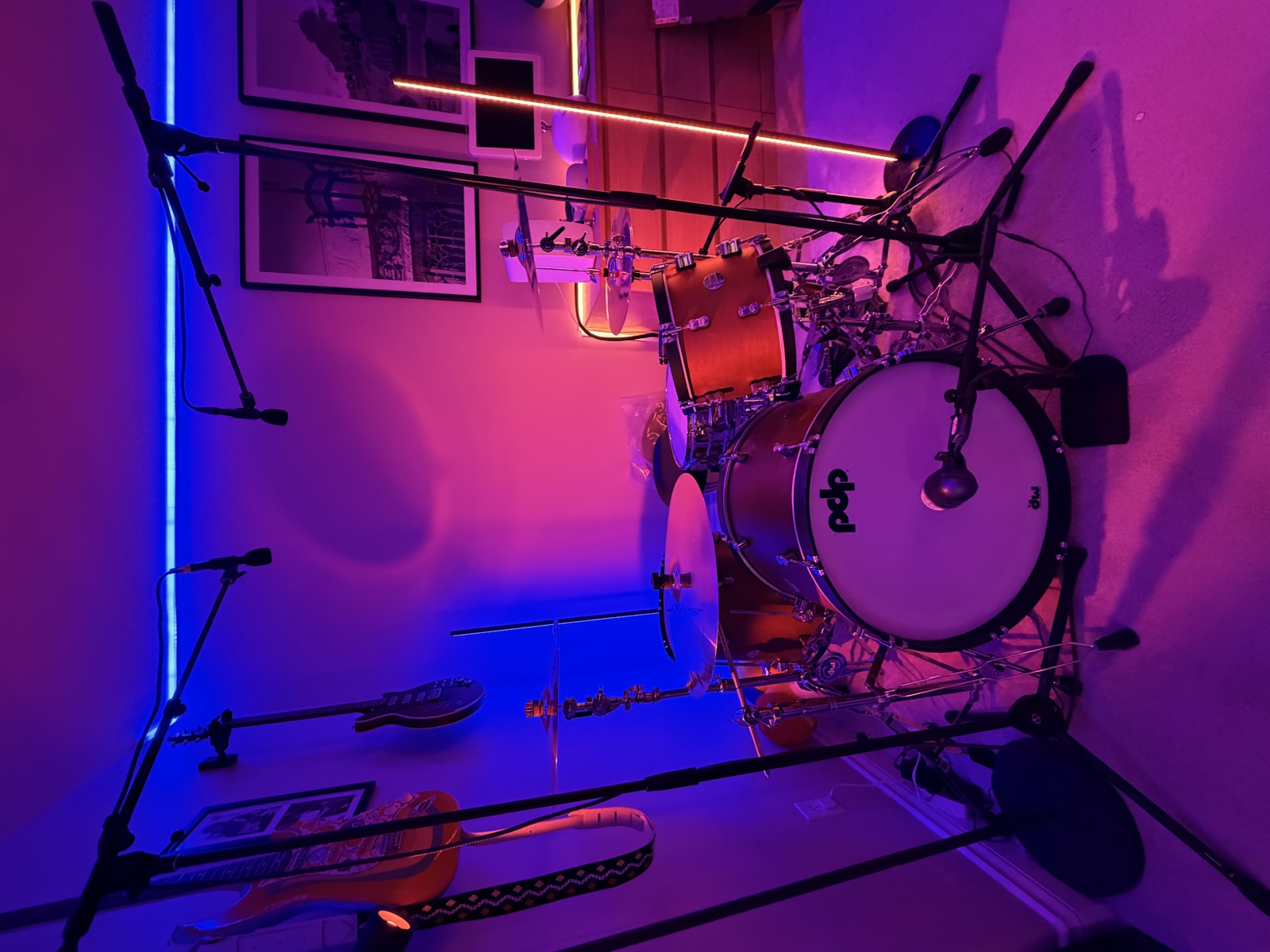
There is a drum kit in the room where I work, two basses on the wall, microphones on stands and lighting rigged for video. This is not a hobby corner. When a client needs an original track for a launch film, or a shoot that cannot be done with stock, we make it here. Owning production capability changes what an agency can sell, not just what it can make, and that distinction is the whole argument.
Why own equipment instead of hiring it in?
Because ownership changes the answer to a question that gets asked in the middle of a call. When a client says they want an original track under the launch film, an agency that coordinates suppliers says it will come back with a quote and a timeline. An agency with the room says yes and asks what it should feel like. The second answer wins work that the first one never hears about again.
It also collapses the iteration loop. The expensive part of commissioned creative is not the first version, it is the third, because each round has a booking, a schedule and a change fee behind it. When the room is yours, the third version costs an afternoon, and the third version is usually the one that is right.
Build or buy, applied to production capability.
| Capability | Frequency of use | Decision |
|---|---|---|
| Music recording for client films | Monthly across the portfolio | Own it |
| Standard video capture and lighting | Monthly | Own it |
| Specialist camera or lens | Once or twice a year | Hire it |
| Orchestral or large-ensemble recording | Rarely | Hire a studio |
| Editing and post | Continuous | Own it |
What does original production actually fix?
Sameness. Two brands in the same category using the same library track and the same stock footage end up sounding and looking identical, and neither of them notices because they never see the two side by side. Buyers see both. The material that differentiates on paper does not differentiate in the feed.
There is also a licensing dimension that people discover late. Library music carries usage terms that constrain where a film can run and for how long, and the constraint surfaces at the worst moment, usually when a campaign is being extended into a market it was not licensed for. Owning the recording removes an entire category of problem.
Custom work photographs and records the actual product too, which matters more than it sounds. In our own image production we measured that generating a product into a scene in one pass produced three usable results out of three, while compositing it afterwards produced none. Real capture has the same property. Assembled things read as assembled.
How do the economics work?
Through utilisation across a portfolio rather than through one project. A kit, a few good microphones and a camera package do not pay for themselves on a single film. They pay across eight accounts over a year, at which point the per-use cost is small and the response time advantage is permanent.
The mistake is buying capability you use twice. The discipline is the same one we apply to client tooling decisions: buy when the workflow is standard and build when the workflow is the product. Music and video for us sit on the build side because they are used continuously and because the response time is the thing being sold. A specialist camera used once a year sits on the buy side and always will.
Does this make the work better or just faster?
Both, but the mechanism is speed. Quality in creative work is mostly a function of how many iterations you can afford, and iterations are gated by cost per round. Drop the cost per round and the number of rounds rises, and the quality follows from that rather than from any change in taste.
The other effect is that the person with the idea is in the room with the instrument. Ideas that would not survive being written into a brief, sent to a supplier and interpreted three days later get tried in ten minutes. Most of them fail. The survivors are things that would never have been commissioned.
Quality in creative work is mostly a function of how many iterations you can afford. Lower the cost per round and quality follows.
Where is the line for a small agency?
Own what you use every month and what your clients associate with you. Hire what is specialist, expensive and occasional. And be honest about which category something is in, because equipment purchases are unusually vulnerable to being justified by a project that has not been sold yet.
The version of this I would defend hardest is the room itself rather than any individual item. A space where things can be made without booking anything is the actual asset. Everything in this photograph is replaceable. The fact that someone can walk in at seven in the evening and try something is not.
Related: why context beats explanation, the build or buy call and performing before you are ready.
Frequently asked questions
Should a marketing agency own production equipment?
Own what gets used monthly and what clients associate with you. Hire what is specialist and occasional. The test is frequency of use across the whole portfolio, not whether a single upcoming project would justify it.
Why does original music matter for brand work?
Because library tracks make competing brands sound identical, and because usage licences constrain where and how long a film can run. Owning the recording removes both the sameness and an entire category of legal constraint.
Does owning equipment actually improve the work?
Indirectly, through iteration count. Commissioned creative is expensive per round, so teams stop after two. When the room is yours the third and fourth versions cost an afternoon, and the later versions are usually the ones worth shipping.
When should a company build rather than buy a capability?
Buy when the workflow is standard and build when the workflow is the product. We applied the same rule for a client who built a learning centre in-house rather than licensing a course platform, because the workflow was the differentiator.
What is the hidden benefit of in-house production?
Ideas get tried instead of briefed. Anything that has to be written up, sent to a supplier and interpreted days later has to survive a process. In-house, a bad idea costs ten minutes, which means more of them get tested and the surprising ones survive.
How do you avoid over-investing in equipment?
Do not justify a purchase with a project that is not yet sold. Equipment decisions are unusually prone to that, and the resulting kit sits unused while still occupying the budget that a genuinely frequent need would have used.
Sources
- Chua Network delivery data across 8 client accounts (internal fact bank)
- Chua Network engagement records, anonymized (internal experience bank)