The short version
- Small operators keep the whole business in one visible place. Funded teams distribute it across tools until nobody can see it at once.
- Show-only pricing is a deadline mechanic, and deadlines are the most reliable conversion tool in existence. Most B2B pricing has none.
- A two-person stand forces a clear sentence about the product because there is no budget for abstraction.
- Before adding systems, ask whether anyone can currently see the whole business on one screen. If not, more tools will make it worse.
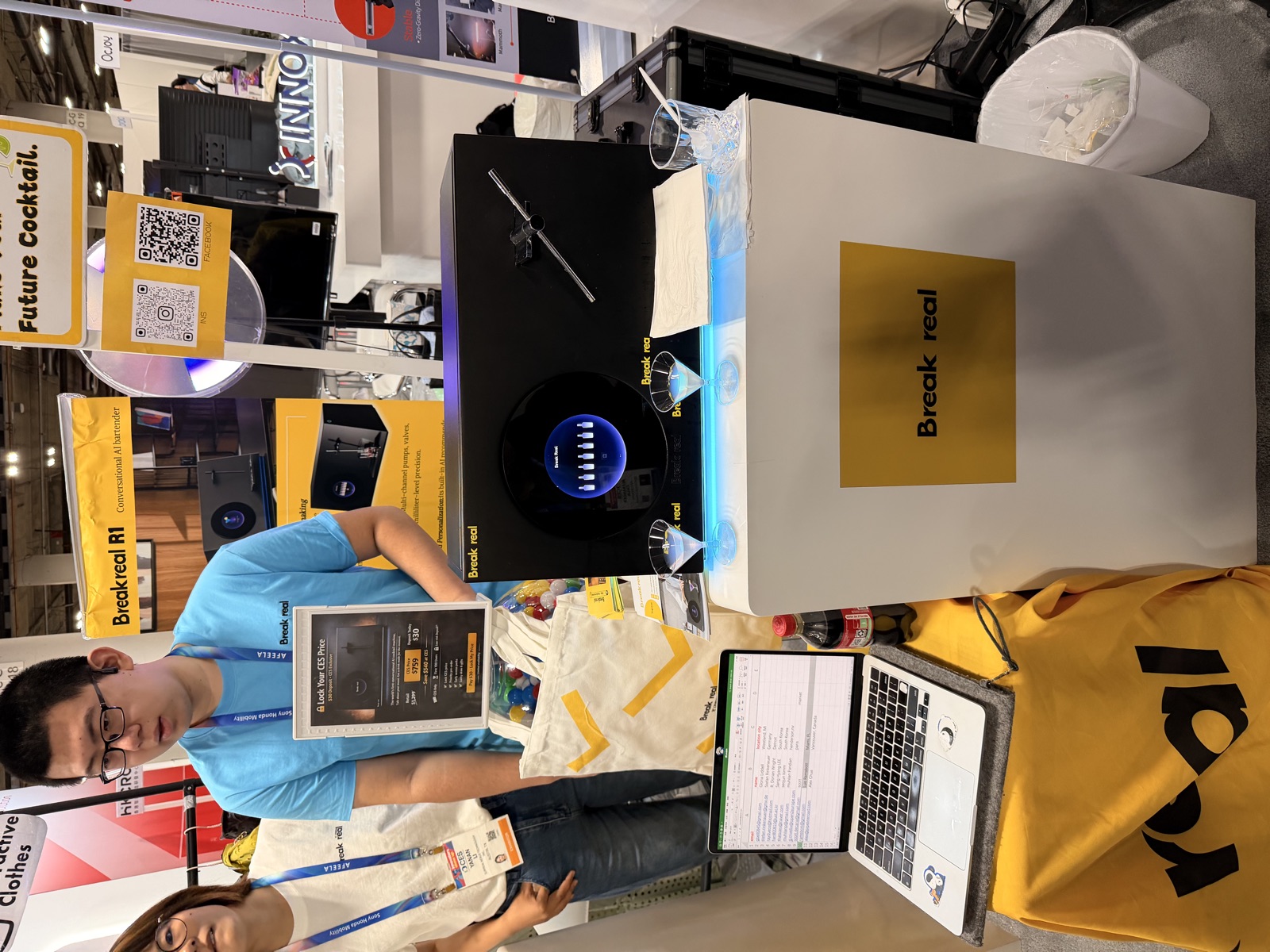
This stand had a machine that mixes drinks, a sign offering a show-only price, two people working it, and an open laptop on a stool with a spreadsheet on the screen. Everyone else photographed the machine. I photographed the laptop. That spreadsheet is the most honest artefact on the floor, because it is the whole company: inventory, leads, pricing and margin in one place, visible, being updated between conversations.
Why does the spreadsheet matter more than the machine?
Because it is the operating system. Two people running a stand cannot afford a CRM, an inventory tool, a pricing model and a reporting layer that do not talk to each other, so they have one sheet and they can see everything at once. That is not a limitation they are suffering under. For a business at that size it is a genuine advantage.
The comparison that interests me is with much larger companies where the same information exists but is spread across five systems, none of which agree. On one account we audited, roughly 92 percent of the raw traffic was bot, which nobody had noticed because the number lived in a tool that nobody read against a definition nobody had agreed. Visibility is not the same as instrumentation.
When a spreadsheet stops being the right tool.
| Trigger | Why it matters | What to add |
|---|---|---|
| Two people writing at once | Silent overwrites | A shared system of record |
| An error costs more than the tool | Risk exceeds convenience | The narrowest tool that fixes it |
| Reporting takes longer than acting | Time moves to admin | Automated reporting, not a new CRM |
| A tool ceiling is hit mid-campaign | Work stops without warning | Check every limit before designing |
| Nobody can see the whole business | Problems hide between systems | One weekly surface, whatever the stack |
What is the show price actually doing?
It is manufacturing a deadline. The sign offers a price that ends when the show ends, and that is the entire mechanic. It works because the alternative to deciding now is not deciding later, it is not deciding at all, and everyone selling anything knows this.
B2B software has largely abandoned the deadline and replaced it with a discount that is available whenever the quarter is ending, which buyers learned to wait for. A real deadline has to be tied to something outside the seller’s control, which is what an event date provides for free.
The version of this that works without a trade show is a cohort. Onboarding that starts on a date, a programme with a defined intake, a delivery slot that is either available in October or is not. Any of those is more honest than a discount, because it reflects a constraint that exists whether or not the buyer is looking.
What do two-person teams get right about messaging?
They say what the thing is. There is no room for a layer of abstraction between the visitor and the product because there is no second person to explain it. The sign says what the machine does, the machine does it in front of you, and the conversation starts from a shared understanding rather than working toward one.
Compare that with a larger stand where three levels of message have accumulated, each added by a different stakeholder, and the visitor has to excavate. Constraint is a message-clarifying force and companies lose it exactly when they can afford to.
When should a business graduate off the spreadsheet?
Later than most people think, and for a specific reason rather than a general sense of maturity. The trigger is not revenue. It is when more than one person needs to write to the same record at the same time, or when a mistake in the sheet costs more than the tool would.
The failure I see repeatedly is adding systems before adding process. A tool encodes a workflow, so if the workflow is undefined the tool encodes the confusion and makes it permanent. On one account, a lead sync from an ad platform through to an email tool broke silently every time a form was swapped, because the integration was built on identifiers rather than on an agreed process.
The other trigger is a ceiling. Check the limits of every tool in the chain before you design around it. We had a campaign hit a free tier that capped sends at 300 per day, mid-flight, which is the sort of thing you find in the documentation in ten minutes and in production at the worst possible moment.
A tool encodes a workflow. If the workflow is undefined, the tool encodes the confusion and makes it permanent.
What is the lesson for a company that is no longer two people?
Keep one surface where the whole business is visible, even if the systems underneath have multiplied. It does not need to be a spreadsheet and it does not need to be sophisticated. It needs to be a single screen that someone looks at every week and would notice if it went wrong.
We run a weekly cadence across all eight client accounts for the same reason. The point is not the meeting. The point is that once a week, someone looks at the whole thing at once, which is precisely what the person at that stand was doing between drinks.
Related: how I run a research trip, why tool limits bite mid-campaign and product lines that do not connect.
Frequently asked questions
When should a small business move off spreadsheets?
When two people need to write to the same record at once, or when a single error would cost more than the tool. Revenue is a poor trigger. Concurrency and risk are the real ones.
Why do event-only prices work so well?
Because the deadline is outside the seller's control. Quarter-end discounts train buyers to wait, since the same discount reappears predictably. A date that exists independently of the sales team cannot be waited out.
What is the B2B equivalent of a trade show price?
A cohort or a build slot. Onboarding that starts on a fixed date or capacity that is genuinely limited creates a real deadline, which is more honest and more durable than a discount.
Why do small teams communicate more clearly?
Because they cannot afford abstraction. With no one available to explain the product, the sign has to do the work. Larger companies accumulate layers of message from multiple stakeholders and lose the constraint that produced clarity.
What goes wrong when companies add tools too early?
The tool encodes an undefined workflow and makes the confusion permanent. Integrations built on identifiers rather than agreed process also break silently, which is worse than breaking loudly because nobody is alerted.
How do you keep visibility as a company grows?
Maintain one surface where the whole business can be seen at once, and look at it on a fixed cadence. We review every account weekly for this reason. The value is not the meeting, it is that somebody looks at everything in one sitting.
Sources
- Chua Network delivery data across 8 client accounts (internal fact bank)
- Chua Network engagement records, anonymized (internal experience bank)