The short version
- A second product does not extend a brand automatically. It only extends it if the customer can state the connection in one sentence.
- The connection has to be a shared job or a shared buyer, not a shared technology. Technology overlap is invisible to the person deciding.
- When nobody is standing at the table, the brochure is the product line. Most companies never review it under that condition.
- Naming carries more weight than it gets. Two unrelated product names force the buyer to do the integration work that the company avoided.
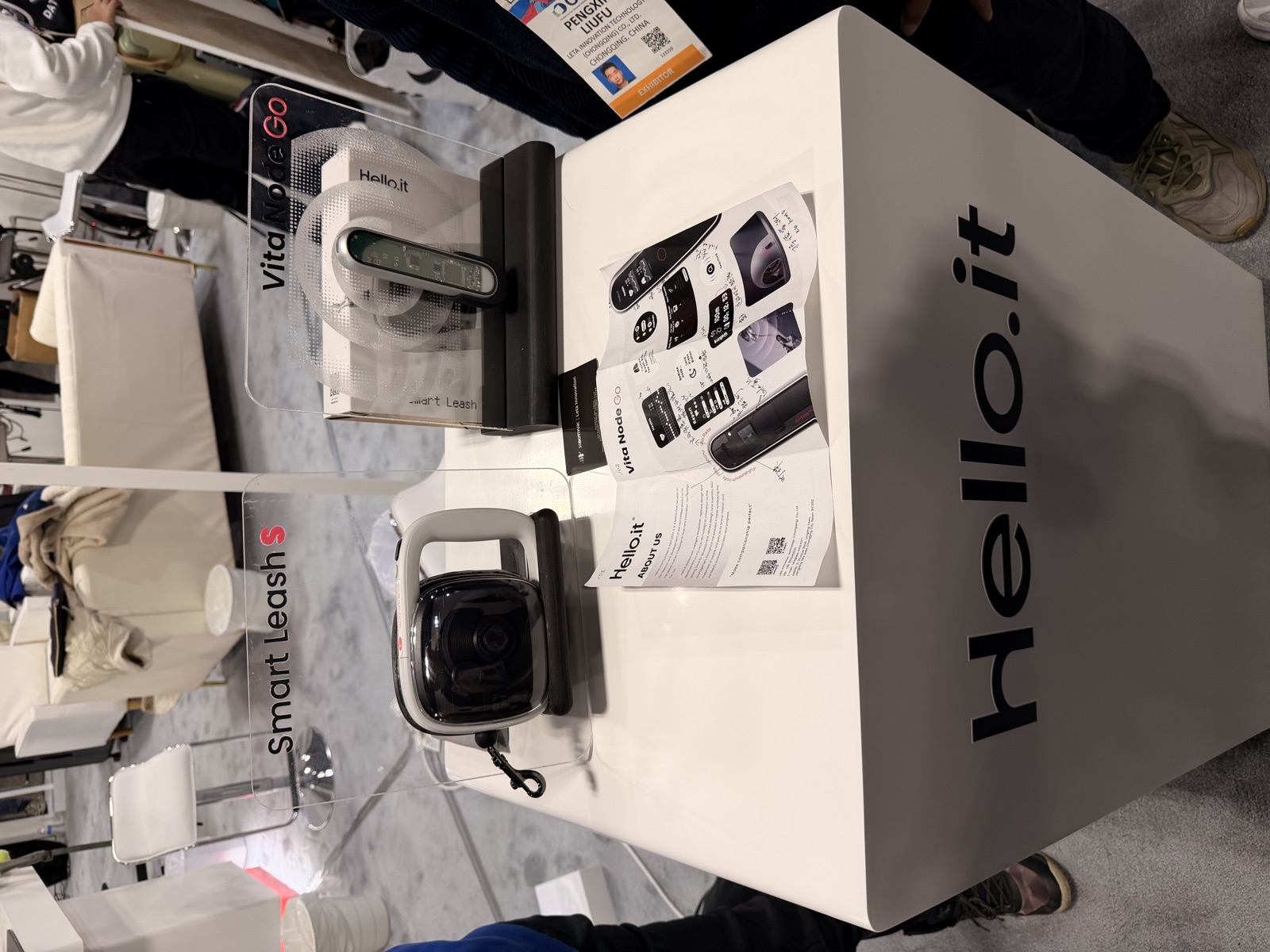
On one small plinth sat two products from the same company, each under its own acrylic sign, with a folded brochure between them. One was a camera in a handle. The other was a slim monitoring device. Both looked well made. Nothing on that table told me why one company made both, and by the time I had worked it out I was two stands away. A product line without a connecting line is not a portfolio. It is a set of unrelated bets that a buyer has to reconcile on your behalf.
What makes a product line read as a line?
One of three things. Either the products serve the same job at different stages, or they serve the same buyer across different jobs, or they compose into a system that is worth more assembled than apart. Any of the three can carry a line. What cannot carry a line is a shared component, a shared factory or a shared engineering team, because none of those are visible to the person deciding.
The table in front of me had no visible answer to that question. Two devices, two names, two audiences implied. It might well be one of the three cases, and I could not tell in three seconds, which is the entire budget available.
What can and cannot connect a product line.
| Connector | Visible to the buyer | Carries a line |
|---|---|---|
| Same job, different stage | Yes | Yes |
| Same buyer, different job | Yes | Yes |
| Products compose into a system | Yes, if shown assembled | Yes |
| Shared technology or platform | No | No |
| Shared engineering team or factory | No | No |
| Shared founder or origin story | Occasionally | Weakly, and only in consumer |
Why does the connection have to be stated rather than implied?
Because buyers do not perform integration work for vendors. If a company has two products and the relationship between them is left as an exercise, the buyer chooses the one that matches their immediate problem and forgets the other exists. The cross-sell that justified building the second product silently never happens.
This is one of the more expensive quiet failures in product marketing. The engineering cost was real, the launch happened, and the strategic reason for the second product, which was usually to increase account value, does not materialise because nobody told the customer the two things belong together.
We see the same pattern in services. An agency lists twelve capabilities and the client buys one, because a list is not a sequence. Once the same capabilities are presented as stages of one programme, clients buy more of them without being sold harder.
How much work is the naming doing?
More than most teams allow for. Two product names with no shared structure force the buyer to remember two separate things and to invent the relationship. Names that share a stem, a suffix or an obvious hierarchy do that work in advance, at no ongoing cost.
This is not an argument for boring names. It is an argument for a naming system decided once rather than a series of independent naming decisions made whenever a launch is imminent. The independent decisions are always cheaper on the day and always more expensive over five years.
The other half of naming is casing and spelling discipline. It sounds trivial until you run a content programme and find the product written three ways across a site, which is a small credibility leak on every page it appears on.
What does the unattended test tell you?
Stand away from your own booth, page or brochure and evaluate it as if no one is there to explain it. That is the condition under which most of your material is actually consumed. Nobody is standing beside your pricing page at two in the morning when a buyer is comparing you against two competitors.
In practice this means the printed sheet on that table had to carry the entire line story, and it did not. It described each product separately, in sequence, exactly as the stand did. Two accurate descriptions in one document do not produce a relationship between them.
Buyers do not perform integration work for vendors. If the relationship between two products is left as an exercise, it does not happen.
How do you fix a line that does not read as one?
Write the one sentence first. Something of the form: we make X for people who Y, and the second product exists because after Y they need Z. If that sentence is hard to write, the line problem is real and no amount of design will hide it. If it is easy to write, the fix is mostly presentation and it is cheap.
Then put the sentence everywhere the products appear together, including the places where they appear as a list. Navigation, brochure, pricing table, and the stand. A line that is only explained on the about page is not a line.
For a three-brand operator we worked with, the correct answer went the other way. Each brand needed its own voice, its own ideal customer and its own positioning, because shared ownership is not shared positioning. Sometimes the honest conclusion is that these are two companies sharing a logo, and the line should be dropped rather than manufactured.
Related: positioning under three seconds, turning taste into a checklist and what small operators get right.
Frequently asked questions
How do you know if a product line is coherent?
Write one sentence that states why the second product exists for the buyer of the first. If the sentence is difficult to write, the incoherence is real and presentation will not fix it. If it is easy, the problem is that you have never put the sentence anywhere.
Does shared technology justify a product line?
Not to a buyer. Platform overlap is an internal efficiency, not a customer-facing reason to consider both products. The connection has to be a shared job or a shared buyer to be visible from outside.
How much does product naming matter?
More than most teams budget for. A naming system decided once does the work of connecting products permanently and for free. Independent naming decisions made per launch are cheaper on the day and considerably more expensive over several years.
What is the unattended test?
Evaluating your material under the condition it is actually consumed in, which is with nobody available to explain it. Most brochures, booths and pricing pages are designed as if a person will be standing next to them, and most of the time nobody is.
Should every multi-product company present a unified line?
No. Where one owner runs genuinely different brands with different buyers, the right answer is separate positioning for each, because shared ownership is not shared positioning. Manufacturing a line that does not exist confuses both audiences.
Why does cross-sell fail after a second product launches?
Usually because the customer was never told the two products belong together. The engineering happened, the launch happened, and the connection was left implicit, so buyers pick the one matching their immediate problem and never learn about the other.
Sources
- Chua Network delivery data across 8 client accounts (internal fact bank)
- Chua Network engagement records, anonymized (internal experience bank)