The short version
- A video call is a structured turn-taking exercise. It removes the two parts of a meeting where the useful information lives: the ten minutes before, and the walk out.
- The trip is not the meeting. The trip is permission to have the conversations that never get their own calendar invite.
- We run weekly delivery cadence on every account. In-person is what the cadence cannot produce, not a replacement for it.
- The rule I use now: fly when the thing that is stuck is trust or scope, not when the thing that is stuck is a decision.
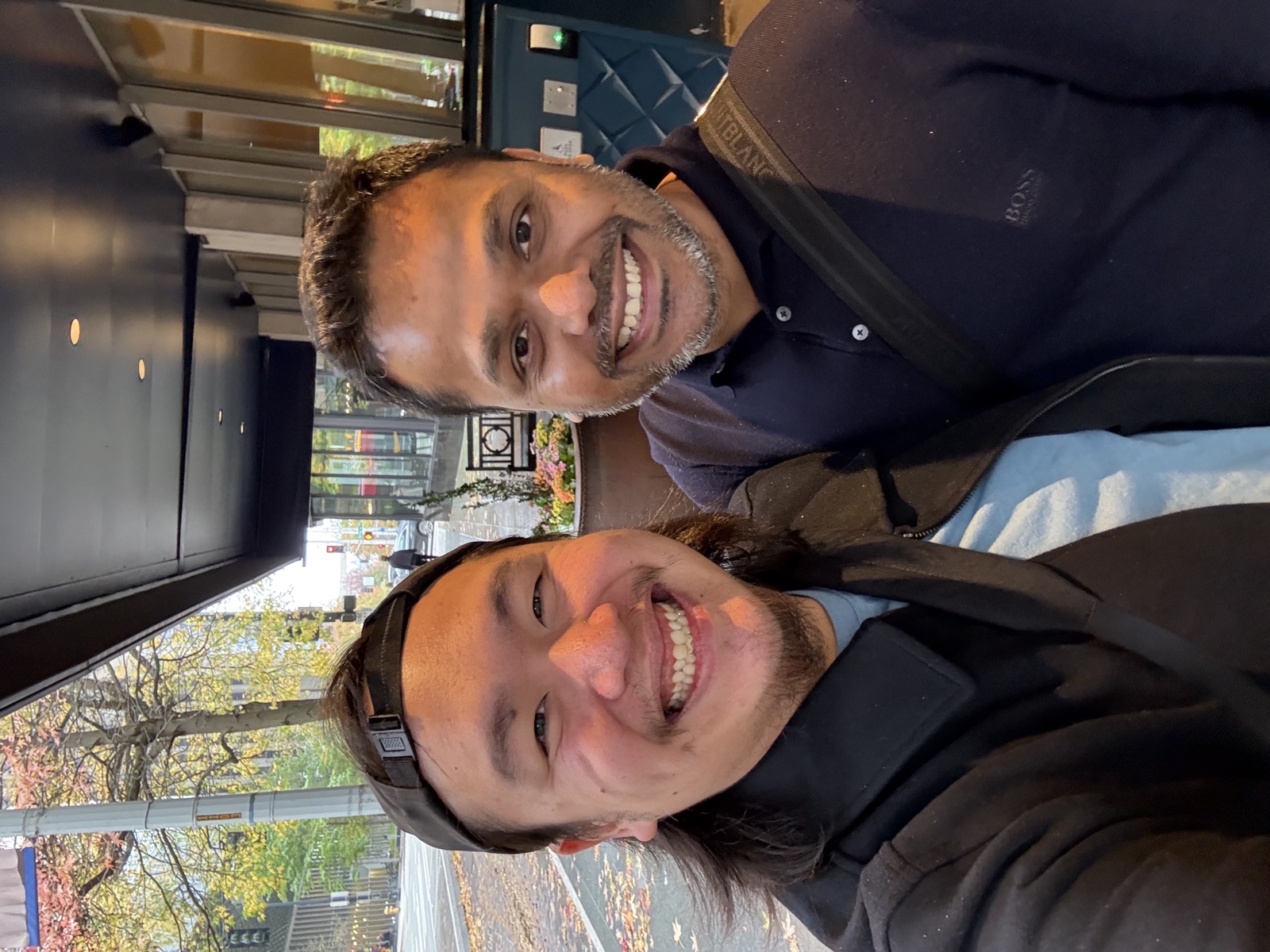
We had worked together for about a year before this photograph was taken. Weekly calls, shared documents, a running thread of decisions. Then I flew down for a day, and forty minutes on a pavement outside a coffee shop moved the account further than the previous eleven months of scheduled video had. I have thought about why ever since, because if a flight beats a year of calls, that is a scheduling problem, not a travel budget problem.
What does a video call actually leave out?
It removes the unstructured time on both ends. A call starts when it starts and ends when the next one begins. Nobody arrives fifteen minutes early and stands around. Nobody walks you to the lift and says the thing they were not going to say in front of the others. Across eight client accounts, the pattern is consistent enough that I now treat it as a property of the medium rather than a habit we could fix with better facilitation.
It also enforces a single speaker. On a call, one person talks and everybody else waits. In a room, three conversations can run at once and recombine. That matters most in the early phase of an engagement, when the useful work is finding out what people actually believe rather than what they agreed to say on the call.
And it flattens seniority in a way that sounds democratic and is not. Everyone is the same size rectangle, so the person who is quiet stays quiet. On the sidewalk in this photo I learned things about how decisions were actually made inside that company which had never come up on a call, and they changed how we sequenced the next stretch of work.
Signals I use to decide whether something needs a flight.
| Signal on the account | How it shows up on video | What being there fixes |
|---|---|---|
| Scope keeps re-opening | Same clause revisited every third call | You find the person whose incentive the scope threatens |
| A quiet stakeholder | Camera off, never speaks, has a veto | They talk in corridors, not in meetings |
| Decisions agreed then reversed | Polite agreement, no follow-through | You learn who actually signs |
| New relationship, large build | Everything sounds fine | Mental models get compared before code does |
| A pure decision with clear options | Works fine | Nothing. Do not fly. |
When is it worth flying for a meeting?
My rule is that you fly when the blocker is trust or scope, and you do not fly when the blocker is a decision. Decisions travel fine over video. A decision has options, owners and a deadline, and all three of those survive compression. Trust does not compress, and neither does scope, because scope disputes are usually trust disputes wearing a spreadsheet.
The other trigger is a new relationship carrying a large commitment. If we are about to start something with 42 routes and several hundred CMS records behind it, I would rather spend a day in the same building than discover in week six that two people had different mental models of what we agreed. That specific rebuild taught me the cost of the alternative.
What do you actually do with the day on the ground?
Not what most people do, which is fill it with meetings until the flight home. I block roughly half of it. The unbooked half is where you get invited to the thing that was not on the agenda: a walk to lunch, a desk tour, ten minutes with the person who actually operates the tool you are about to redesign.
I also try to meet at least one person who is never on our calls. Support, operations, whoever answers the inbox. They know which promises the company keeps and which it does not, and they will tell you in a corridor what nobody will write down.
Then I write it up the same day, before the flight. Not notes for the client. Notes for us: what surprised me, what I now think is wrong in our plan, and which assumption I would bet against. If it waits until the next morning, the specifics are gone and you are left with a feeling.
How does one trip pay for itself over the following year?
Because it changes the default. After you have stood next to someone, the messages get shorter and the escalations get slower. People give you the benefit of the doubt for months on the strength of one afternoon, which is an unreasonable return and also an observable one.
It also compounds into the work. Most of what we learned on this trip ended up as positioning input rather than relationship warmth. You hear the phrases people actually use for their own problem, and those phrases are worth more than a month of keyword research because they are the language the buyer already thinks in.
You fly when the blocker is trust or scope. You do not fly when the blocker is a decision.
What does this change about running remote accounts?
We did not stop running remotely. Weekly cadence on every account is the operating model and it works. What changed is that I stopped treating in-person as a reward for a healthy relationship and started treating it as the intervention for an unhealthy one. If an account has gone quiet, that is the signal to book something, not the signal to send a better status update.
The failure mode to avoid is the annual visit that exists because it is annual. A trip with no specific thing that is stuck turns into a lunch and a slide deck. The photograph at the top of this page is from a trip with a specific thing that was stuck, and I remember what it was.
Related field notes: why the meal is where the real conversation happens, what a hologram booth taught me about remote presence and the trip where I halved the schedule and got more out of it.
Frequently asked questions
Is travelling for client meetings worth the cost for a small agency?
Selectively, yes. The test is whether the blocked thing is a relationship problem or an information problem. Information problems are cheaper to solve over video. Relationship and scope problems tend to stay blocked until someone is physically present, and a blocked account costs more per week than a flight.
How often should you visit a remote client?
Less often than most people assume, and always for a reason. A standing annual visit with no specific objective usually turns into a lunch. I would rather do one unscheduled trip when something is genuinely stuck than three ceremonial ones.
What should you actually do during an in-person client day?
Leave about half the day unbooked, meet at least one person who never attends your calls, and write up what surprised you before you fly home. The value is in the unstructured time, so booking the day solid removes the reason you went.
Does in-person work still matter for a fully remote team?
Yes, and for the same reason. We run weekly delivery remotely across every account, which handles throughput. It does not handle the informal information that only exists in corridors, and no cadence of status updates substitutes for it.
How do you justify the trip internally?
By naming the blocker before you book. If you cannot write one sentence describing what is stuck and why presence would unstick it, the trip is a morale expense rather than a delivery one. That is sometimes fine, but it should be labelled honestly.
What is the biggest mistake people make on client trips?
Filling the calendar. The second is treating the trip as a presentation opportunity. You learn more in a day of listening than you gain from a day of pitching, and the listening is the part you cannot do from home.
Sources
- Chua Network delivery data across 8 client accounts (internal fact bank)
- Chua Network engagement records, anonymized (internal experience bank)